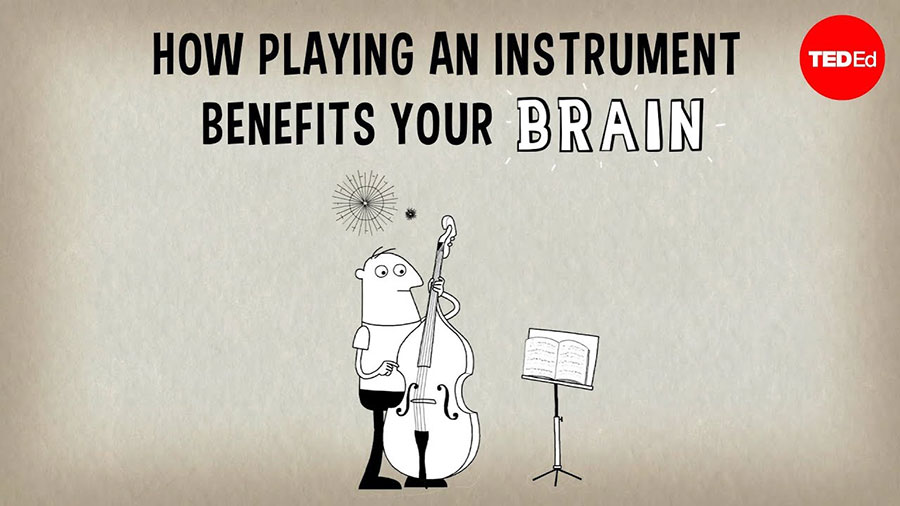
Parents often hear that music is “good for the brain,” but modern neuroscience now shows just how powerful learning an instrument can be—especially for growing children.
Thanks to advances in brain imaging technology such as fMRI and PET scans, researchers can now observe the brain in real time. What they’ve discovered is remarkable: when children listen to music, multiple areas of the brain light up. But when they play music, the brain becomes dramatically more active—engaging in what neuroscientists describe as a full-body workout for the brain.
What Happens in the Brain When Children Play Music?
When a child picks up an instrument, their brain doesn’t work in isolation. Instead, many regions activate at once. The brain processes sound, reads symbols, controls precise physical movements, and interprets rhythm and melody—all within fractions of a second.
Playing an instrument engages:
- The auditory cortex (listening and sound processing)
- The visual cortex (reading music and visual cues)
- The motor cortex (fine motor skills and coordination)
- Both hemispheres of the brain simultaneously
This level of whole-brain engagement is rare in other learning activities.
How Playing an Instrument Benefits Your Brain
Music Strengthens Brain Connections
One of the most significant findings in music research involves the corpus callosum—the bridge between the left and right hemispheres of the brain. Studies show that children who learn instruments often develop a larger, more active corpus callosum, allowing information to move faster and more efficiently across the brain.
This enhanced connectivity helps explain why music students often show improvements in:
- Problem-solving
- Logical reasoning
- Creativity
- Emotional understanding
- Academic learning across multiple subjects
Music, Memory, and Executive Function
Music education doesn’t just improve coordination—it strengthens executive function, a set of skills that includes planning, focus, attention to detail, and emotional regulation.
Research also shows that musicians develop stronger memory systems. When learning music, the brain stores information in multiple ways—auditory, emotional, visual, and contextual. This “multi-tagging” makes memory recall faster and more reliable, much like a powerful search engine.
For homeschooling families, this means music learning supports not just music skills, but learning across literacy, numeracy, and life skills.
Is Music Different From Other Activities?
Researchers have asked whether the benefits of music are unique—or whether similar effects come from sports or other creative activities. While all learning is valuable, studies suggest that music stands apart because it combines:
- Mathematical precision
- Language processing
- Fine motor control
- Creativity and emotional expression
In controlled studies where children began with similar cognitive abilities, those who undertook music learning showed greater improvement in multiple brain areas compared to peers who did not.
Why This Matters for Homeschooling Families
For homeschooling parents, music education is not an “extra”—it’s a powerful learning tool. Whether through structured instrumental lessons, music appreciation, or daily practice, playing music supports whole-child development in ways few activities can match.
The research continues to grow, but the message is already clear: learning an instrument helps children build stronger, more connected, and more adaptable brains—skills that last well beyond childhood.